Real Data Selling App | Data बेचकर पैसे कमाने वाला App | Earn Money Online in Hindi | Data sale
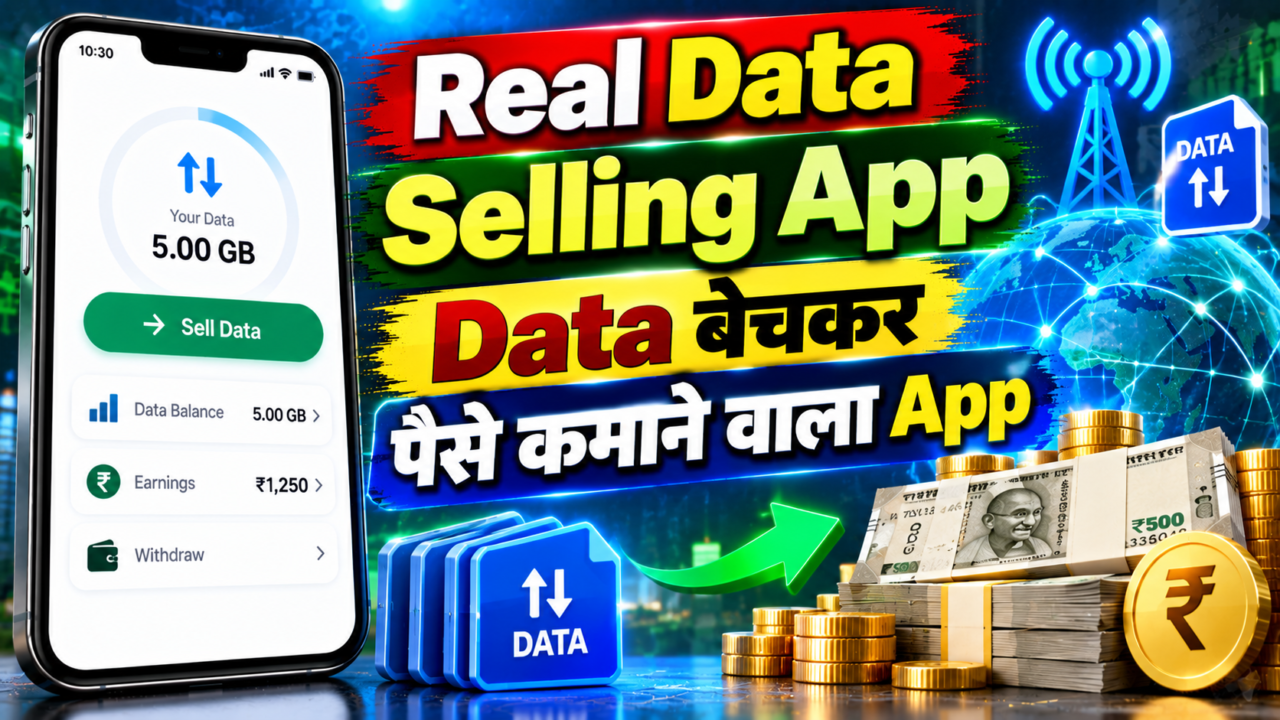
Real Data Selling App | Data बेचकर पैसे कमाने वाला App | Earn Money Online in Hindi
The idea of a “Real Data Selling App” has become popular because many people see videos and posts claiming that they can earn money simply by selling their internet data. But there is an important difference between selling personal data and sharing unused internet bandwidth. These two things are often mixed together, even though they are not the same.
Some apps claim to reward users for sharing unused internet bandwidth, while other apps use surveys, referrals, advertisements, tasks, cashback, or other reward systems. There are also websites and apps that make unrealistic earning promises, so it is important to understand exactly where the money comes from before trusting an application.
One well-known example in the bandwidth-sharing category is Honeygain. According to its current official information, Honeygain describes its service as allowing users to share unused internet bandwidth with business customers, with earnings depending on factors such as traffic demand, location, connection uptime, and other conditions.
However, Honeygain currently states that its application is for users aged 18 or older, so it should not be treated as an option for someone under 18.
What Does “Data Selling” Actually Mean?
When people search for a “data selling app,” they may actually be talking about several completely different business models.
The first model is internet bandwidth sharing.
In this model, you are generally not selling your personal photos, messages, passwords, or private files. Instead, the application uses a portion of your unused internet connection and routes permitted traffic through your connection.
Honeygain, for example, explains its model as sharing unused bandwidth with business partners for purposes such as market research, web statistics, price comparison, SEO-related activities, ad verification, and content delivery.
That is why the term “sell internet” can sometimes be misleading. What is actually being monetized is unused network capacity, rather than your personal files.
How Does a Bandwidth-Sharing App Work?
The basic process is relatively simple.
You install an application, connect your device to the internet, and allow the application to operate in the background. The service then uses some of the available bandwidth according to its system and terms.
The company may have business customers that need residential internet connections for legitimate web-related activities. The customer pays the company, and the company shares a portion of the revenue with participating users according to its earning system.
Honeygain describes its process as:
- Install the application.
- Connect the device to the internet.
- Share unused bandwidth.
- Business partners use the network for permitted activities.
- The user accumulates rewards.
- The user can request a payout after reaching the applicable threshold.
So, technically, this type of application can have a real business model behind it.
But that does not mean every application advertising “data selling” is genuine.
Is “Data Selling” Really Selling Personal Data?
This is one of the biggest misunderstandings.
There are two completely different concepts:
Personal-data selling:
An application collects information about people and potentially monetizes that information.
Bandwidth sharing:
An application monetizes unused internet/network capacity.
A legitimate bandwidth-sharing service should clearly explain what is being shared, why it is being shared, who uses it, how rewards are calculated, and what information the application itself collects.
For example, Honeygain says that its bandwidth-sharing system does not access users’ personal files, messages, or browsing history, while its privacy policy separately explains categories of personal information that the service itself processes.
This distinction is extremely important when evaluating any “Data Selling App.”
What Determines the Earnings?
One common misconception is that installing an application automatically generates a large amount of money.
Usually, earnings depend on demand and usage.
Factors can include:
- Internet connection availability
- Location
- Network type
- Amount of traffic demanded in that region
- How long the application remains connected
- Number of eligible devices
- Current rates offered by the platform
- Availability of business demand
Honeygain specifically says that earnings can depend on location, network demand, connection uptime, and the number of devices being used.
Therefore, two people can use the same type of application and receive very different results.
This is why claims such as “Earn thousands every day just by selling your data” should be treated very carefully.
Different Types of Apps That People Call “Data Selling Apps”
The term “data selling” is now used for several different earning models.
1. Internet Bandwidth Sharing Apps
This is the closest match to what people normally mean when they search for a genuine internet data-selling application.
The application shares unused bandwidth, and the user receives rewards according to the amount of qualifying traffic and the platform’s current rates.
Honeygain is an example of this model. Its official website currently describes the service as an internet-bandwidth-sharing platform rather than a service that sells users’ personal files.
2. Survey and Opinion Apps
Some applications pay users for answering surveys.
Here, you are not selling internet data. Instead, the company is collecting opinions and research responses.
The reward may be provided as points, gift cards, vouchers, or other eligible rewards.
This is a completely different model from bandwidth sharing.
3. Cashback and Reward Apps
Some applications give rewards for shopping, completing eligible offers, or using promotional services.
Again, this is not technically “selling data.”
The company generally earns money through merchants, advertising partnerships, affiliate arrangements, or promotional campaigns and may return a portion of that revenue to users.
4. Referral-Based Reward Apps
Some applications offer rewards when you invite other users.
The important thing is to understand where the money comes from.
A referral bonus can be a legitimate marketing expense, but an application that depends almost entirely on continuously recruiting people and promises unusually high returns should be examined very carefully.
5. Offer and Task Apps
Some reward platforms pay users for completing specific activities, such as eligible promotional offers, app trials, surveys, or other tasks.
The exact conditions can vary significantly.
Users should always read the requirements before assuming that simply completing an activity guarantees a reward.
6. Research and Data-Contribution Platforms
There are also services where users voluntarily contribute information for research or analytics.
These can involve surveys, usage information, consumer research, or other forms of participation.
The important question is always:
What information is being collected, why is it collected, who receives it, and what reward is offered in return?
What About Apps That Claim to Pay for Mobile Data?
This is where people need to be especially careful.
When an application says “Sell your mobile data and earn money,” it can mean several different things.
It could mean:
- sharing unused bandwidth,
- participating in research,
- completing surveys,
- viewing advertisements,
- completing promotional offers,
- referring users,
- or collecting certain categories of information.
These are not interchangeable.
A real bandwidth-sharing service cannot magically turn every 1 GB of mobile data into a large cash payment. There has to be a business reason for someone to pay for that network traffic.
Also, mobile data itself has a cost. If an application uses your mobile data to generate a very small reward, the economics may not make sense for you.
Can These Apps Actually Work?
Some bandwidth-sharing models are technically real.
Honeygain, for example, documents a system in which users share internet traffic and receive credits based on qualifying usage. Its current terms explain that the user’s device can function as a gateway for traffic used by business clients, including companies involved in areas such as web and market analytics, SEO monitoring, brand protection, market research, and cybersecurity.
However, “the business model exists” does not mean “every app claiming to use this model is legitimate.”
A real application should have things such as:
- Clearly identifiable company information
- Published terms and conditions
- A privacy policy
- A transparent explanation of the earning model
- Clear payout requirements
- Information about what network resources are used
- A reasonable explanation of its business customers
- Clear age and eligibility requirements
If an application cannot explain where the money comes from, that is a major warning sign.
Why Do Some Data-Selling Apps Show Large Rewards?
Many earning applications use rewards, bonuses, referral programs, or promotional campaigns to attract users.
For example, a platform may show:
Bonus → Referral Reward → Daily Reward → Special Offer → Extra Earnings
But these numbers should not automatically be interpreted as guaranteed cash.
A reward displayed inside an application may have conditions such as:
- Minimum withdrawal amount
- Limited-time offer
- Verification requirement
- Specific task requirement
- Geographic restriction
- Referral requirement
- Account eligibility
- Maximum reward limit
Therefore, the headline reward is not necessarily the amount that every user can withdraw.
How Do Payouts Work?
Different platforms use different payout systems.
Some may offer:
- PayPal
- Bank transfer
- Gift cards
- Prepaid cards
- Digital wallets
- Cryptocurrency
- Platform-specific points or credits
Honeygain currently describes a $20 minimum payout threshold and lists PayPal and other payout options depending on the applicable system. Its terms also state a $20 minimum withdrawal threshold and explain conditions surrounding unused balances.
This is another reason why users should read the actual payout rules instead of relying only on screenshots or social-media videos.
Important Privacy Questions
Before installing any earning application, check its permissions.
Ask:
Does the app need access to my contacts?
Does it need my location?
Does it need storage access?
Does it need my microphone or camera?
What personal information does it collect?
Does it share information with third parties?
Why does it need that information?
The FTC also recommends checking what information an application wants to access and reviewing its privacy policy before installing it.
An application asking for unnecessary permissions should be treated cautiously.
The Difference Between a Real App and a Fake “Data Selling” App
A genuine earning platform should be able to explain its business model.
For example:
Business pays platform → platform uses network/service → platform earns revenue → eligible users receive a portion as rewards.
A suspicious application may instead say:
Install → deposit money → invite people → unlock higher income → deposit more money → guaranteed daily profit.
That second pattern is very different from bandwidth sharing.
Be especially cautious if an application asks users to pay money first in order to withdraw supposedly earned money.
Also be careful with screenshots showing extremely high balances without independent evidence that the money can actually be withdrawn.
Can You Make a Full-Time Income From Data Selling?
Usually, you should not assume that a bandwidth-sharing application will replace a normal income source.
The amount earned depends on demand, location, connection, uptime, and the platform’s current rates. Honeygain itself says earnings vary according to factors such as location and network demand.
So these services are better understood as a particular type of reward/passive-income model, not as a guaranteed salary.
And because individual platforms can change their rates, payout rules, supported devices, or eligibility requirements, an earning figure shown today may not remain the same indefinitely.
Is the “Live Data Selling” Concept Shown in Apps Real?
A user interface showing:
Data Sold → Session Earnings → Progress → Wallet Balance → UPI Withdrawal
can certainly be designed as an application interface.
But a screen showing “1 GB sold” and “₹50 earned” does not by itself prove that real data has been sold or that money has been added to a real wallet.
For a real system, there must be an actual backend connecting:
User device → Network traffic → Business/customer demand → Revenue → User reward → Verified payout
Without that backend infrastructure, the interface is only a simulation.
This is an important distinction when looking at demo applications and videos online.
Final Verdict: Do Data Selling Apps Really Exist?
Yes, some internet-bandwidth-sharing business models are real.
But the phrase “data selling” is often used too broadly.
A legitimate bandwidth-sharing service generally monetizes unused internet bandwidth rather than simply taking your personal information and selling it. Honeygain is one documented example of this model, and its official documentation explains how its network operates and how users are rewarded.
At the same time, not every application using the words “Data Selling,” “Sell Internet,” “Earn From Data,” or “Earn Money Online” should be trusted.
The safest approach is to look beyond the earning number and understand the actual business model.
If an app clearly explains what is shared, who pays for it, how rewards are calculated, what information is collected, what permissions are required, and how withdrawals work, it is much easier to evaluate.
If it simply promises huge earnings, asks for unnecessary personal information, or requires money before allowing a withdrawal, you should treat it as a warning sign.
Most importantly, “selling data” does not automatically mean selling your private personal data. In many cases, the term actually refers to sharing unused internet bandwidth. Understanding this difference is the key to understanding how real data-selling and bandwidth-sharing apps work.
Session Data



 Help
Help